Five Kingdom Classification
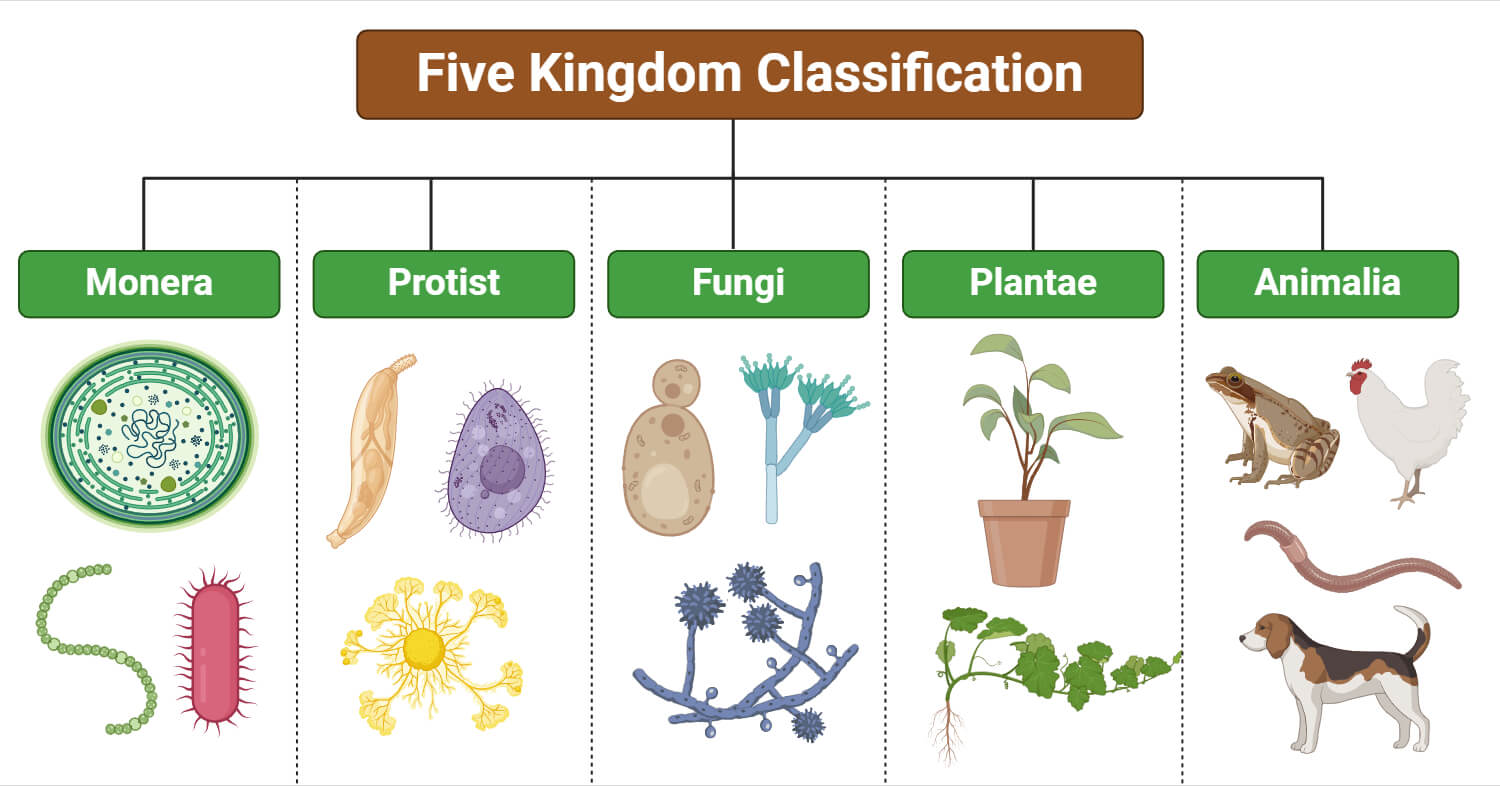
In 1969, Robert H. Whittaker proposed the Five Kingdom system to classify all living organisms.
It improved earlier systems by properly placing prokaryotes, fungi, and unicellular eukaryotes.
Key points (click to reveal):
Proposed by
R.H. Whittaker (1969)
Five Kingdoms
Monera, Protista, Fungi, Plantae, Animalia
Advantage
Better placement for fungi and prokaryotes
🧬 Most widely accepted system in biology!
History of Classification
Classification systems evolved over time to better organize living organisms.
Key developments (click to reveal):
Two Kingdom
Linnaeus (1735): Plantae & Animalia
Three Kingdom
Haeckel (1866): Added Protista
Four Kingdom
Copeland (1938): Separated Monera
Five Kingdom
Whittaker (1969): Added Fungi
Classification Criteria

Whittaker used five main criteria to divide organisms into kingdoms.
Criteria (click to reveal):
Cell Structure
Prokaryotic vs Eukaryotic
Body Organization
Unicellular vs Multicellular
Cell Wall
Presence and composition
Nutrition
Autotrophic vs Heterotrophic
Phylogeny
Evolutionary relationships
Kingdom Monera
Explore the Amoeba (Protist Example)
Click on any part to see its name and function
Cell Membrane
Part Information
Click on any part of the amoeba to see its name and description
Includes all prokaryotic organisms like bacteria.
Key features (click to reveal):
Cell Type
Prokaryotic, unicellular
Cell Wall
Peptidoglycan
Nutrition
Autotrophic or heterotrophic
Reproduction
Asexual (binary fission)
🦠 Examples: Bacteria, Cyanobacteria
Kingdom Protista
Explore the Paramecium
Click on any part to see its name and function
Cell Membrane
Part Information
Click on any part of the paramecium to see its name and description
Mostly unicellular eukaryotes, diverse group.
Key features (click to reveal):
Cell Type
Eukaryotic, mostly unicellular
Nutrition
Autotrophic or heterotrophic
Movement
Cilia, flagella, or pseudopodia
🦠 Examples: Amoeba, Paramecium, Euglena
Kingdom Fungi
Explore a Fungal Cell
Click on any part to see its name and function
Cell Wall
Part Information
Click on any part of the fungal cell to see its name and description
Heterotrophic eukaryotes with chitin cell walls.
Key features (click to reveal):
Cell Type
Eukaryotic, mostly multicellular
Cell Wall
Chitin
Nutrition
Absorption (saprophytic)
Reproduction
Spores
🍄 Examples: Yeast, Mushrooms, Molds
Kingdom Plantae
Explore a Plant Cell
Click on any part to see its name and function
Cell Wall
Part Information
Click on any part of the plant cell to see its name and description
Multicellular, photosynthetic eukaryotes.
Key features (click to reveal):
Cell Type
Eukaryotic, multicellular
Cell Wall
Cellulose
Nutrition
Autotrophic (photosynthesis)
Movement
Non-motile
🌱 Examples: Mosses, Ferns, Trees, Flowers
Kingdom Animalia
Explore an Animal Cell
Click on any part to see its name and function
Cell Membrane
Part Information
Click on any part of the animal cell to see its name and description
Multicellular, heterotrophic eukaryotes without cell walls.
Key features (click to reveal):
Cell Type
Eukaryotic, multicellular
Cell Wall
Absent
Nutrition
Heterotrophic (ingestion)
Movement
Most are motile
🐾 Examples: Sponges, Insects, Fish, Mammals