Monocotyledons vs Dicotyledons

All flowering plants (Angiosperms) are divided into two major groups based on the number of cotyledons in their seeds:
• Monocotyledons (Monocots) → one cotyledon
• Dicotyledons (Dicots) → two cotyledons
• Monocotyledons (Monocots) → one cotyledon
• Dicotyledons (Dicots) → two cotyledons
- Monocots
- Dicots
- Basis of division
Detailed Comparison Table
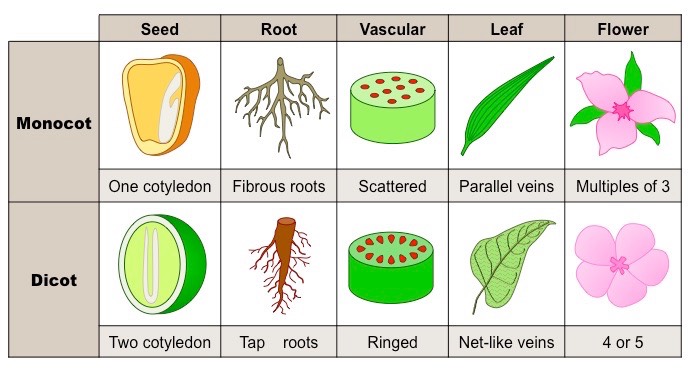
| Feature | Monocotyledons | Dicotyledons |
|---|---|---|
| Cotyledons in seed | One | Two |
| Leaf venation | Parallel | Reticulate (net-like) |
| Root system | Fibrous / adventitious | Tap root system |
| Vascular bundles in stem | Scattered | Ring arrangement |
| Flower parts | Multiples of 3 | Multiples of 4 or 5 |
| Pollen grains | One furrow / pore | Three furrows / pores |
| Examples | Grass, Rice, Wheat, Maize, Lily, Onion | Mango, Pea, Rose, Sunflower, Mustard, Bean |
3. Monocotyledons (Monocots)

Usually herbaceous plants with parallel-veined leaves and scattered vascular bundles
- One seed leaf
- Parallel veins
- Adventitious roots
- No cambium ring
- 3, 6, 9 petals etc.
4. Dicotyledons (Dicots)

Usually have tap roots, net-veined leaves and vascular bundles in a ring
- Two seed leaves
- Network of veins
- Tap root system
- Cambium present
- 4, 5, 8, 10 petals etc.